Saturday, 22 August 2015

Stunning Somerset

Somerset is one of my favourite places to visit in Britain and it is stunning on so many levels. Some might say that it does not boast high mountains, rugged coastlines or magnificent beaches; but I would argue that its beauty is much more subtle than that. There is the beauty in its landscapes, in its historic buildings, in its friendly people and its wildlife is truly stunning.
During our Somerset trip we stayed in a great little holiday cottage called Little Spring Barn in the tiny village of Blackford, near Wedmore on the south side of the Mendip Hills:
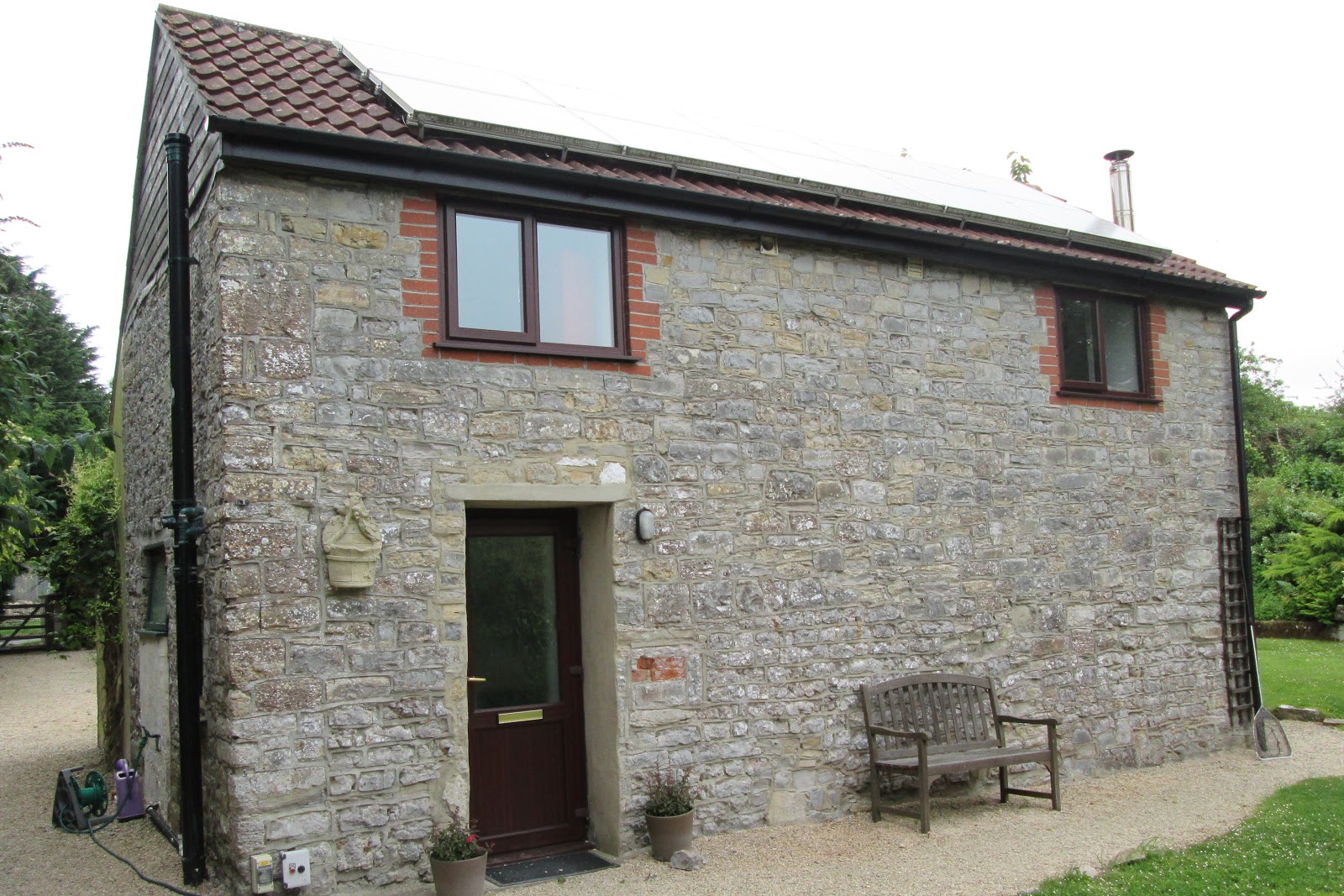
Little Spring Barn
The cottage overlooked a lovely garden complete with a large pond fed directly from a natural spring (hence the name of the barn):

Garden With Pond
When we first arrived we were greeted by the guard dog, which after some initial barking went on to give us a tail-wagging friendly welcome every time we returned from our trips out. Her name was Speck and if I could have got away with it I would have brought her home with me....

Speck the Guard Dog
Don't be fooled by her size and friendly face, she was there to keep the foxes away from the chickens and a good job she did to. She slept outdoors in her own little kennel and was also ready to bark at any intruder, and we witnessed out the upstairs window why she had to be on her guard:


I wonder if Speck was the reason why the fox had a limp?
After a peaceful night in the barn we were ready for our first outing, which was a trip to Barrington Court near Yeovil. We were meeting up with our niece Fiona and her family who live in Yeovil.
Barrington Court was a lovely place with lots of open spaces for young Harry to run around in plus an old stately home with lots of nooks and crannies for him to explore:

With Fiona & Family at Barrington Court

Flower Beds at Barrington Court
Me, Fiona and the Barrington Court Jester

We had a really good day there and the weather was lovely. As a bonus we were treated to a delicious roast chicken dinner back at Fiona's house...........mmm! Then it was a drive back to the 'Barn' for a good night's sleep in the hay loft (it was really a luxurious bed in the tastefully decorated bedroom).
The next day we took a trip to a nearby nature reserve called Shapwick Heath which sits slap-bang in the middle of the Somerset Levels. It is a fantastic place for wildlife as it has a wide variety of habitats including reed-beds, woodlands, open water and wildflower meadows:
 
Shapwick Heath NNR - Reed-beds

Shapwick Heath NNR - Noah's Lake
 The main reason for the abundance of wildlife is the fantastic habitats it offers insects; and where there is plenty of insect life there is plenty of birds, mammals, amphibians, reptiles etc. There are those that feed on the insects and those that feed on the insect-feeders.
Let us start with the insects themselves, and in particular the dragonflies and damselflies. There is no place in Britain I have been (even Norfolk) that come close to featuring such an abundance of damselflies and dragonflies. They are however not the easiest to photograph or video, but here are a few examples from Shapwick Heath.
Firstly a mass of Common Blue Damselflies sunning themselves on the brambles:


These blue damselflies can have slightly different patterns but in general are all the common blue variety. However I did manage to get a short video of another species of blue damselfly, known imaginatively as the Variable Damselfly:


As I said these damselflies are everywhere and in these shelter corners can collect in huge numbers.
There are also a large number of their bigger cousins, the Dragonflies, however these incredible predators are very hard to capture on video as they fly so fast.
I did however manage to film a couple of Four-spot Chasers having a dog-fight over a prime hunting perch:


I just had to be patient until one of them landed for a few second for a breather so I could film it close up. The Four-spot Chaser is one of the more common species of dragonfly, but I think you will agree that it is a magnificent creature never-the less:


Our attempts to emulate the flying prowess of a dragonfly appear somewhat cumbersome; as a helicopter flew overhead just to emphasis the point:


The large water channels that run through the reserve and drain all the water from the surrounding fields are called Rhynes (pronounced 'reens' by the locals) and these are not only a haven for insects but also for insect-loving fish:


Where there are fish that eat insects there will be birds that eat fish; such as the Great Crested Grebe, the Heron and of course the elegant Great White Egret:


Fair enough it might not look so elegant when it is flying, but it does when it is on the ground; think of it like an albino Heron.......but more graceful.......and elegant!!
Some birds cut out the middle man and feed directly on the insects; birds such swallows, swifts, wagtails and of course warblers such as this noisy, territorial, Sedge Warbler:


Some of these warblers such as Sedge Warblers, Whitethroat and Chiffchaff are summer visitors to Britain, spending their winters south of the Sahara Desert. They fly all this way just so they can eat our insects and feed them to their chicks, a long way to go for a few damselfly!!
Before we leave Shapwick NNR here is a video of another insect eater............a Common Frog:


Enough wildlife for now, we did go other places and see other things. For instance we went to the seaside, Weston-Super-Mare to be precise and had a really super day:

Oil Painting of Weston-Super-Mare Beach
It isn't really an oil painting of the beach, just my shaky camera work.
Anyway, one place that Moira always wanted to visit was the Jill Dando Memorial Garden at WSM, so we went there first:

Moira at Jill's Garden
 The garden was created by Alan Titchmarsh in memory of Jill Dando, the TV presenter who was murdered on her own doorstep a few years ago. She originally came from Weston.

In Jill's Garden at Weston
It was a lovely tranquil place, only a short distance from the busy promenade.
I have to confess that I also enjoyed the wildlife in the garden pond:


After a cup of coffee and a bun in the café at the gardens we had a wander along the promenade to visit the famous Weston-Super-Mare Grand Pier. The original pier burnt down in 2008 and was rebuilt a couple of years later, so I had never been on the new pier but had fond memories of the penny slot machines on the old pier.

On the Grand Pier at Weston

Treats This Way
I was pleased to find that they still had a lot of penny machines (well 2p machines) on the Grand Pier and we must have spent about an hour playing them. It was great fun and Moira even won a ceramic teddy bear to take home as a memento:

Pierre the Bear
I have christened him Pierre, which is a Grand name for a bear (or maybe Teddy Edward!!)
After a bite to eat at a water-front café we headed back to the cottage, taking a slight detour so we could drive through the famous Cheddar Gorge (no it is not made of cheese!)
Moira took some snaps as we drove through the gorge:

At the Start of Cheddar Gorge

Driving Through the Gorge

Watch that Car!!
We stopped in the lovely little village of Cheddar at the foot of the Gorge and had an ice cream before we headed back to the cottage.
The next day we took a little trip down memory lane and visited the pretty town of Somerton, where my sister and her family use to stay. We enjoyed browsing through the various shops, had a cream tea in one of the little cafes and posed beside the historic market cross:

Moira at Somerton Market Cross
On the way back from Somerton we visited another nature reserve belonging to the RSPB. It was called Greylake and although much smaller than Shapwick NNR it was not short of wildlife to look at, some of it very interesting (honest!):
As we walked along a grassy path leading to the bird hides we noticed a male Mute Swan on the path up ahead. We then noticed there was a whole family of Swans on the path, and mother Swan decided that it was time to move all of their cygnets back into the water:


Father Swan did not look best pleased that we had disturbed their siesta. I counted eight healthy cygnets.....fantastic!!
These were not the only baby birds we saw at RSPB Greylake; there were young Coots learning to dive, young Lapwings running around in long grass trying to avoid being trampled by cattle feeding in the meadow and young Mallards also dodging the cow's hooves as they followed on behind mum heading for the safety of the water.
We were also fortunate enough to see a few less common bird species such as this Reed Warbler which made a fleeting appearance from within the reeds:


One of the key reasons that the Reed Warbler is becoming less common is that it is the preferred host for the Cuckoo; which lays a single egg in the Reed Warbler's nest when it is left unattended. The egg is so well disguised that the Reed Warbler cannot distinguish it from its own eggs and continues to incubate them. When the Cuckoo chick hatches it proceeds to throw all the other eggs out of the nest so it can be the sole chick raised by the Reed Warbler.
This has really started to impact on Reed Warbler numbers over recent years, and we even heard a Cuckoo calling from a nearby tree not far from where we saw the Reed Warbler at RSPB Greylake, so it may well have been another victim.
As well as the Reed Warbler and the Cuckoo we saw another exciting summer visitor...................... a Hobby:


This fantastic falcon hangs in the sky before swooping down at great speed to catch small birds and large flying insects; which its plucks out of the air with ease, often eating them whilst on the wing.
Even the voracious Dragonfly is no match for the speed and agility of this top predator and often features on its menu.
The scientific name for the Hobby (Falco subbuteo) was also alleged to be the inspiration behind another hobby, the table-top football game called Subutteo.
Our next trip out was a much more sedate affair, it was a lovely sunny day and we went on a mission to find one of Britain's rarest butterflies...........the Large Blue!!
Acting on a tip from our good friend Jim (who is a keen birder/butterflier) we headed to Collard Hill near Glastonbury to find this elusive creature. It wasn't a particularly high hill but did afford a lovely view across Somerset:

View from Collard Hill
I could see immediately why butterflies would be attracted to this area as it was full of lots of lovely nectar-bearing wildflowers (including this pretty Pyramidal Orchid :

Pyramidal Orchid

Collard Hill Wildflowers
The Large Blue however prefers not to lay its eggs on orchids but on wild Thyme and Marjoram, but that is not the intriguing part of its lifecycle.
When the caterpillars hatch from the eggs they initially feed on the buds of these 'host' plants then after their third moult they drop to the ground where they are carried by red ants back to the ants' nest (they appear to mimic an ant grub to fool the ants). Here they feed on the ants' eggs and grubs until they are large enough to hibernate over winter inside the nest. The following spring they pupate before crawling back out the nest to spend the rest of their life as a butterfly. In other words they are a bit like a Cuckoo.
Anyway these butterflies are very difficult to find if you are on your own and don't really know what you are looking for. Fortunately for us there were a handful of helpful butterfly enthusiast about and they pointed us in the right direction, so here it is:

Large Blue Butterfly
Don't be fooled by the name........it is tiny........... each wing is about the size of a twenty pence piece........ just as well there were some helpful Large Blue spotters about.
With that rarity in the bag we took a trip along to visit one of my favourite English cities............Wells. Often described as England's smallest city (although in reality the City of London is smaller) it retains lots of its medieval buildings, including the magnificent Wells Cathedral:

Wells Cathedral
The main square in Wells is surrounded in historic buildings:


Moira in Wells
And the wonderful Bishop's Palace has a dramatic entrance and moat, with swans that swim up to the entrance gate and ring a bell to be fed (honestly, they do!!)

Bishop's Palace Entrance Gate

Croquet on Bishop's Lawn

Moira at Bishop's Palace


Bishop's Palace Moat
Just a beautiful and peaceful place to visit....I love it.

So that is our Somerset trip in a nutshell (albeit a very big nutshell with lots of photos and videos); never-the-less I hoped you enjoyed it and can understand why I think Somerset is stunning and well worth a visit.

I'll give you a rest for a few weeks before I post another blog

Take care,

Teddy Edward


Thursday, 9 July 2015

Delightful Dorset


Our annual holiday this year was in The West Country, and in particular the delights of Dorset and Somerset. We managed to strike a balance between having a relaxing holiday and cramming a lot in; so much so I have split this blog posting to cover Dorset first and I will do Somerset later.
On our trip down south to Dorset we broke the journey with an over-night stay in Worcester. We stayed in the Premier Inn which was attached to Worcester Cricket Club, however there was no cricket on that night, but we did have a fine view of Worcester from our room window:
Worcester from Hotel Window
Once we had unpacked we took a little walk over the bridge and along the banks of the River Severn.

Bridge over the Severn

Churches on the Banks of the Severn
Once on the bridge we could see the real religious focus of Worcester, its magnificent Cathedral:

Worcester Cathedral
Despite being an early Tuesday evening the river was quite busy with rowing boats, such as this coxed eight racing boat passing a large group of swans:

Coxed Eight and Swans
On a more light-hearted theme (but I'm sure just as physical) there was this dragon boat completed with drummer beating out the rhythm for the rowers:

Dragon Boat on River Severn
The next morning we left Worcester and headed south to the picturesque Dorset town of Lyme Regis where we would be staying in a lovely guesthouse for three nights.
Lyme Regis is built on the side of a steep valley which leads down to the sea (the English Channel to be precise) and our guesthouse was near the top of the hill and boasted fantastic views. We even had our own balcony where we were served breakfast and could enjoy the view over Lyme Bay:

View from our Balcony
It was such a nice afternoon when we arrived we decided to leave the unpacking to later and took a leisurely stroll down to the waterfront. We skirted along the side of the river Lim as it meandered down towards the sea. Stopping at a bench by the river for a brief rest we saw an elegant Grey Wagtail busily hopping from stone to stone feeding on insects:


We continue on our walk passing by some of the historic features of Lyme Regis including a water mill which has existed for seven hundred years and (with some restoration) is still grinding wheat to make flour for bread. Reaching the waterfront at the east end of Marine Parade we took in the lovely scenery of Lyme Bay and the Jurassic Coast:

Lyme Bay and the Jurassic Coast
Moira at Lyme Bay

Looking West along Marine Parade
We promenaded along Marine Parade to the west end of the town before making our way back up the hill through Langmoor Gardens and Lister Gardens. It may have been a leisurely stroll down from the guesthouse to the waterfront but I can safely say that it took twice as long and twice as much effort getting back up to the guesthouse. The views from the gardens were however worth stopping for:

Lyme Beach from Langmoor Gardens

The Harbour and The Cobb from Langmoor Gardens
We had a well earned rest in the guesthouse before we journeyed back down the hill for our evening meal, then back up the hill in time for bed.....phew!!
The next day we took a short drive to the nearby town of Sidmouth which is another Lyme Bay resort a few miles to the west of Lyme Regis.

Moira on the Prom at Sidmouth

Sidmouth Promenade
 The weather wasn't so sunny this day but it was still comfortably warm. There was a little bit of wind and the waves were crashing on to the pebble beach at Sidmouth.

Me and Crashing Waves
It is an area where the force of the waves have been eroding the cliffs for thousands of years, and the red cliffs at Sidmouth have had their fair share of landslides. This is good news if you are a fossil hunter as new finds are unearthed quite regularly; however not good news if you have a house at the top of the cliffs.
The power of the waves can best be demonstrated in this video taken at the west end of the promenade where the incoming sea lifts up thousands of large pebbles, which then roll back down the beach making a very eerie roaring noise:


As it was near to Sidmouth, it seemed silly not to visit the RSPB Reserve at Aylesbeare Common, just in case there were some rarities about. A twenty minute drive up and down the rolling hills of Dorset/Devon took us there and we had just stepped out of the car when a fellow visitor pointed out that a Dartford Warbler was singing in the gorse bushes opposite the car park.
We could certainly hear it singing but failed to get any sight of it before it disappeared. We then crossed the road and into the reserve continuing to look for anything of interest.

Moira Scanning for Rarities
We were barely ten minutes in to our walk around the reserve when we heard a Dartford Warbler singing again; this time it flew to the top of a bush and we had a great view of it. It even hung about long enough for me to capture it on video:


It may not look too spectacular on my video but the Dartford Warbler is a very rare bird to see in Britain. You really have to come to these upland heathlands in southern Britain to stand any chance of seeing one.
Aylesbeare Common is not just renowned for its rare birds it also has quite a few of the less common butterflies. Unfortunately it was quite breezy that day and any butterflies we did see were flying past at 100mph making it difficult to even identify them never mind photograph or video them.
We did however manage to capture this Green Hairstreak butterfly as it stopped for a rest for a few moments before re-joining the great butterfly chase:


We saw (or heard) a few other interesting birds at Aylesbeare including Yellowhammer, Wren, Chiff-chaff and another species common around here, the Stonechat.
Here is a female Stonechat tidying up its feathers for a night out on the town:


So that was about it for Aylesbeare, we headed back to Lyme Regis for a well-earned rest before braving the hills once again to go out for an evening meal.
The next day the weather started really hot and sunny so we enjoyed our breakfast out on the balcony. We decided to stay in Lyme Regis and enjoy a walk down the town to see the local sites as this was our last full day in Dorset.
First stop was the water mill where we were fortunate enough to catch the first guided tour and learn all about how they use the power of the water to grind the wheat to make the flour that makes the bread. We had to have the obligatory cream tea after that.
By now the weather had changed and it was slightly cooler and looking like a few showers were heading our way. We had a stroll along the new sea wall at the east beach but did not walk all the way to Charmouth as the weather was starting to close in. In fact the rain started as we headed back so we ducked into the nearby Lyme Regis museum.
As the Lyme Bay area is famous for its fossils (hence the Jurassic Coast) you can probably guess that the museum displays were dominated by fossils and  fossil hunters (such as Mary Anning, Lyme Regis's very own palaeontologist from the early 1800s). There were of course other displays about the town and how it was once a thriving port and boasted it's own branch railway line which no longer exists. Most of it however related to the fossil hunters and the historic discoveries that changed our understanding of the geology of the earth and the creatures that inhabited both land and sea.
They even had a model of a ancient species of toothed fish called a Legosaurus:

Reconstruction of a Legosaurus

Legosaurus Close-up
Those astute fossil hunters amongst you will have recognised it is actually a model of an Ichthyosaur made out of Lego.
By the time we left the museum the weather had improved (at least the rain was off) but it still look a bit ominous. We walked along Marine Parade to the Harbour end of the beach where we stopped for a bite of lunch in a seaside café. There were a few boats in the harbour and one or two sitting on the inner harbour wall, including this cheeky little fishing boat:

A Fishing Boat Named Slippery Dick
After lunch we decided to brave the slightly misty weather and take a walk along Lyme's famous outer harbour wall 'The Cobb'.

The Cobb, Lyme Regis
If you've never read the book or seen the film 'The French Lieutenant's Woman' then the significant of The Cobb may be lost on you. Apart from being a fantastic piece of early civil engineering it also featured in this book/film where a woman spends many months on the end of The Cobb staring out at sea waiting for her French lieutenant to return.
In the film Meryl Streep famously played this woman, dress in a black hooded cloak, being battered by the elements at the end of The Cobb. For a brief moment I thought I saw Meryl in her iconic pose on The Cobb, but alas I was mistaken:

The French Lieutenant's Wummin
At least she had the same initials (and the hood).
That was the last of our adventures in Lyme Regis and Dorset, the next morning we rose, crammed our bags into the car and headed for sunny Somerset (but that's another story)

Take care,

Teddyedward


Friday, 29 May 2015

Inner Forth Birding

A couple of weeks back my good friend Grant and I had a day out bird watching at various locations around the Inner Forth area.
We started our trip with a walk along the shoreline between Abercorn and Blackness, benefitting from the shelter of the trees as there was a cold wind blowing in from the Northwest.
Dappled Path from Abercorn to Blackness

Bridge over Midhope Burn
There were plenty of birds singing in the trees, but very few of them popped out to show themselves, so many we had to identify by their song. We managed to recognise Song Thrush, Blackbird, Willow Warbler, Chaffinch, Wren and Robin to name but a few.
At certain points along the walk you could get down on to the shoreline and check for any birds on the river:
Grant checking shoreline for birds
Unfortunately there was very little to see on the river or shoreline as the tide was quite far out, we did see a few gulls and a couple of waders.
We did however get some nice views of Blackness Castle and the villages of Limekilns and Charleston on the opposite shore:
Blackness Castle


Fife Shoreline
We decided to walk back to the car and move on to our next location. Just where we had parked the car (near Abercorn Church) we stopped to admire a redundant Victorian post box, which had been put to good use as a plant holder:
Victorian Plant Holder
We stopped at Blackness Beach for a quick al-fresco picnic before moving on to our next destination which was a ponded area that sits behind the breakwater just North of the village of Skinflats.
I like to refer to this area as 'the land that time forgot' but not in a bad way. It is an area that is farmed but not intensively and reminds me of what farms used to look like when I was young. There are still plenty of hedgerows, there are still damps areas which have not been drained where reed beds thrive and there is a mixture of arable and livestock (cattle) farming.
All this adds up to an abundance of habitats for wildlife, so if you are pining for views of Yellowhammer, Reed Bunting, Sedge Warbler, etc. this is the place to visit.
The changeable weather had turned to heavy rain when we arrived so we gave it ten minutes to die down a bit (which it didn't really) so we ventured out anyway. After a ten minute walk along a hedge-lined lane we came to the ponds and set up our telescopes under the shelter of a Hawthorn bush.
Ponds behind Skinflats (Grangemouth in background)
It was still raining quite heavy so we were surprised to see so many Swallows and House Martins flying about above the pond feeding on insects. We presumed that there must have been a large hatch of flying insects when the sun was shining brightly just before the rain started.
 
Swallows & Martins at Skinflats Pond
Despite the rain there were several other birds out on the ponds including Great-crested Grebe, Tufted Duck and Mute Swans:
Great-crested Grebes

Tufted Ducks
You may be forgiven in thinking that the photograph shows a lovely family of Tufted Ducks on the pond but that could not be further from the truth. What you are actually seeing is one female Tufted Duck (the brown one in the middle) being pursued vigorously by no less than six male Tufted Ducks.
Shortly after this the rain went off and the sun came back out, suddenly everything looked much brighter and shinier and more Spring-like. The flowers suddenly seemed to be more colourful:
Bluebells

Whitebells

Ladybird on Nettles
The trees looked greener and their blossom appeared even brighter:
Crab Apple Blossom

Horse Chestnut Blossom

Pine Cones
 Even the birds started singing ................although they were not hanging about long enough to be photographed. We heard Chiffchaff, Willow Warbler and Blackcap and we also saw Yellowhammer, Robin, Reed Bunting and Sedge Warbler.
There were about 3 or 4 Sedge Warblers in the reeds in front of us at one time but I only managed to get a photo of one which was obscured by the reeds:
Sedge Warbler in Reeds
The view over the ponds had brightened up, however the birds on the water had all disappeared into the reeds:
Skinflats Ponds with Longannet PS in background
We went for a walk down a leafy lane which lead to a small woodland in the hope that we might see even more wildlife:
Leafy Lane

Path Through Woodland
Last time I was here I had good views of a Juvenile Buzzard but today all was quiet apart from a few Chaffinches and the occasional Blackbird. In a field on the West side of the ponds we did see a solitary Canada Goose (which I suspect was not really from Canada but a semi-tame version that you get on most British ponds):
Canada Goose in Field
Having enjoyed our visit to the ponds at Skinflats we thought it was only proper that we also visit another popular attraction in this area and view the animals there............................I am of course referring to the famous Kelpies:
Single Kelpie

Rearing Kelpie

Kelpies
If you have never been to see them yet then I strongly suggest that you do...........they are awesome.
I must go back one evening to photograph them when they are spectacularly lit up.

A magnificent day birding, a picnic on the beach and a bit of artistic culture thrown in as well.......you can't whack it!!

Teddyedward