Saturday, 2 May 2015

Queensferry Crossing

Last weekend we took part in a sponsored walk that involved crossing the Forth Road Bridge from South Queensferry to North Queensferry and back again.
It was a nice day, some sun and a few clouds so I took my trusty little camera with me to snap some photographs. Although it was sunny most of the time there was an icy breeze blowing in from the North, so we were well wrapped up.

At the start of the walk
We left from the South Queensferry end and headed along the East walkway (yes we were doing it the easy way and not climbing up the main cables)

South Queensferry from the Road Bridge
About a third of the way along the bridge walk you come to the first of the towers, where the modern trend of putting padlocks (or should I say lovelocks) on railings appears to have taken off. As sales of these lovelocks go towards the upkeep of the RNLI Lifeboat in Queensferry I can only say it has been a worthwhile venture:

Lovelocks on Forth Road Bridge

Colourful Lovelocks
Some people claim that the reason the Forth Road Bridge was built was to afford good views of the real Forth Bridge (i.e. the rail bridge), I'll let you judge for yourselves:

Forth Rail Bridge from Road Bridge
Halfway across we noticed there were a few yachts out sailing, it looked like a cold but enjoyable hobby in this weather, and what a backdrop!!

Forth Rail Bridge and Yacht
At the second tower we were about two-thirds of the way across the bridge and had a good view of North Queensferry:

North Queensferry from Forth Road Bridge
At the North end of the bridge we had to go down the steps and under the motorway in order to get to the refreshment stalls that had been set up on the entrance to the West walkway.
This provided an ideal opportunity to get a photograph of the new road bridge that is under construction, which is aptly named as the Queensferry Crossing:

New Road Bridge Under Construction
After a quick pit stop, taking on some fuel, we headed on the return journey, this time along the West walkway. This side has been closed to pedestrians in recent months for repair work on the bridge, meaning lack of opportunity to photograph the new bridge construction, luckily it was open for the sponsored walk:

Three Towers of New Bridge

North Tower under construction
As well as viewing the progress of the new bridge, there were a few boats busily going about their business for us to watch. This tug had just steamed out of Rosyth and passed under the Road Bridge as we were crossing:

Tug and New Bridge

Tug with Longannet PS in distance
Half way across we stopped to enjoy the view and another walker kindly offered to take our photograph (almost a selfie, but not quite)

Wrapped up against the chilly wind
We soldiered onwards, stopping before the end to take a few snaps of the new bridge construction at Port Edgar marina. Here they have started pushing the roadway supports out towards the towers:

Port Edgar Marina and New Road Bridge
There were a few yachts moored in the marina, but not as much as I have seen in the past. I guess some sailors have taken their yachts out the water for Winter and not yet returned them, such as these yachts sitting on dry land under the Road Bridge:

High and Dry
Anyway our journey was almost complete, looking over the bridge back at South Queensferry we could clearly see the Parish Church which sits on The Loan:

South Queensferry Parish Church from Bridge
The last part of our journey was a trip through the underpass below the motorway to take us back to where we started:

Tunnel under Bridge
Despite the cold wind we enjoyed our little walk across the Forth Road Bridge and we raised some money for those less fortunate than ourselves.
Thanks to all who sponsored us.

Take care

Teddyedward

Friday, 10 April 2015

Spring has Sprung

What a glorious weekend we had this Easter and the sunshine has certainly put a spring into the step of our wildlife. I have never seen so much activity, especially from our birds, both resident and migrant.
We were down in the Scottish Borders for Easter and the number of birds I saw (and heard) either gathering nest material or belting out their territorial songs was incredible. Allow me to share a few of these experiences with you:
Firstly at the caravan park in Peebles where a Nuthatch was gathering mud in order to prepare a nest hole:

Nuthatches nest in holes in trees, but unlike some birds which start with a small hole opening and widen it to suit their size, the Nuthatch will often start with a bigger hole opening and make it narrower by plastering mud around the edges until it matches their size. Hence the desire to collect mud at the start of the breeding season.
Next up is a little bird renowned for aggressively defending its territory. Whether it be against another bird, a sheep, a cow or in this case a human this little fighter will repel all intruders with a sharp burst of song delivered from a high vantage point...........it is of course the feisty Wren:

After a quick burst of song the Wren usually disappears into the safety of the undergrowth (just in case some of the bigger creatures actually take offence to being chided)
By comparison, high up in a nearby tree a male Blackbird shows off his prowess by singing his beautiful, melodic song in the hope that it will attract the attention of a female Blackbird:
These events were all happening in one small area of the caravan park but all over the site there was evidence that Spring had indeed sprung: from Rooks and Jackdaws flying with sticks to rebuild old nests; Blue Tits collecting moss to line their nests; Chaffinches singing in competition with one another; and the Daffodils bursting out all over:

Rosetta Burn & Daffodils
The place was buzzing, and in particular with huge queen Bumblebees which were bumbling along bumping into things in their search for a hole or crevice to nest in.

The next morning the sun was shining brightly in the clear blue sky as we took a trip along the magnificent Manor Valley just to the south-west of Peebles. Once again the signs of Spring were everywhere. At the start of the valley a colony of Common Gulls (which are not that common) were resting up in a field before searching for nest sites near a river, marsh or loch:

We drove on to the far end of the valley where we went for a walk along the edge of the Dollar forest. Here we were treated to the wonderful sound of a Song Thrush belting out its repetitive song of four distinct notes.
Then in another bush we saw a little Chiffchaff, newly returned from its Winter holidays in the Mediterranean (or there about) and it treated us to it's distinctive song. Some say it sounds like it is repeating its own name.....chiff chaff, chiff chaff, chiff chaff........others say it is calling chip shop, chip shop, chip shop........it depends how hungry you are!!
Anyway I failed miserably in getting a photo or a video of it, but here is one I took back in 2012 in Skinflats, the sound you will have to add yourself:

Chiffchaff

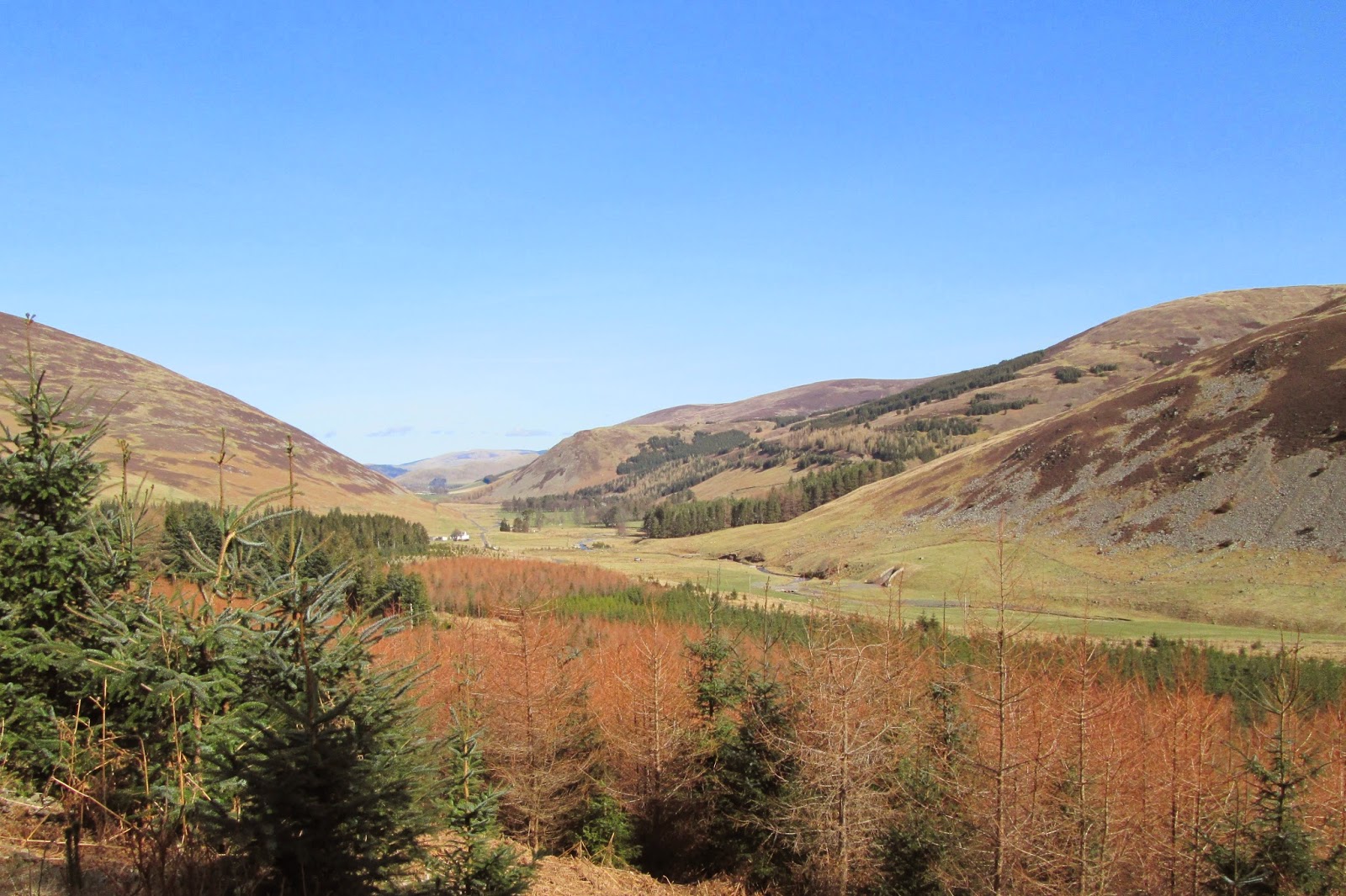
Moving on a bit we came across an opening in the trees which gave us a good view down the Manor Valley, so I snapped it:
Manor Valley from Dollar Forest
It was at this clearing another songster started up, belting his song out with all his might from the top of a conifer, it was of course everybody's favourite the Robin (unless of course you are a competing male Robin!):

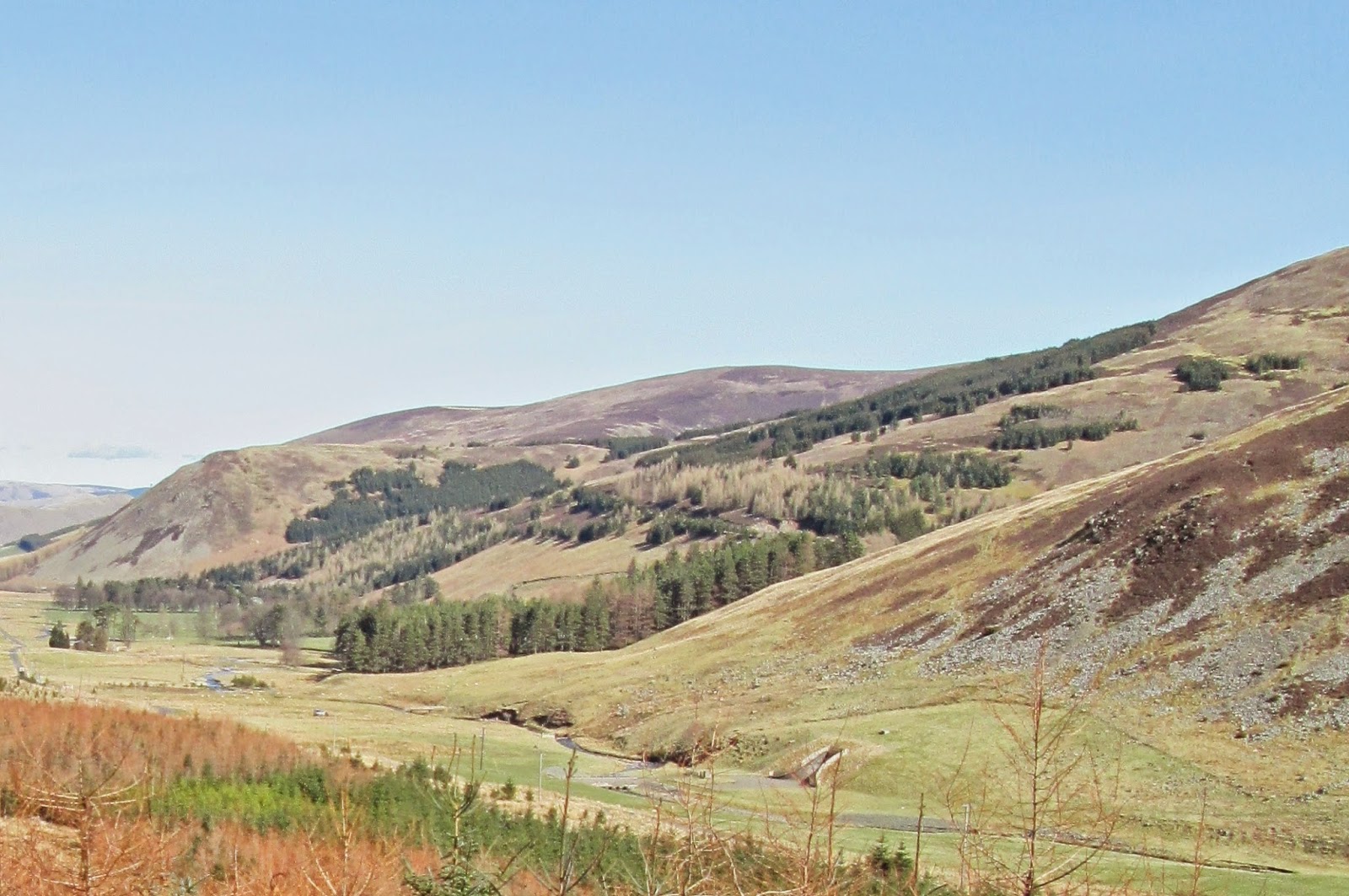
Down on the valley floor the Manor Water winds its way past the imposing hills on its way to join the River Tweed:
Manor Water flowing through Manor Valley
This pebble-based river with its sandy banks proves an irresistible attraction to wading birds and gulls that like to nest in these upland valleys. One such species is the Oystercatcher and we were fortunate to see a whole bunch of these normally noisy waders nestling quietly along the banks of the Manor Water:
This is a far cry from their normal hustle and bustle lives as they feed along the shoreline of coasts and estuaries.
My final offering is a short clip of a male Chaffinch, resplendent in his breeding plumage admiring himself in the wing mirror of a parked car................. or so I thought............... but this has less to do with vanity and more to do with stupidity as he tries to attack his own reflection with obvious results:

Who needs Mad March Hares when you have Crazy April Chaffinches?

Happy Easter

Teddyeddieedward

Sunday, 15 March 2015

Sunshine over Cambus

There is something special about the effect you get when the sun comes out just after some heavy rainfall. How all the trees and bushes sparkle like they are covered in little diamonds and the sky has dark brooding clouds with shafts of sunshine breaking through......I love it.
It is not surprising that in Scotland we get quite a few days like this with our changeable weather and a couple of weeks back I took a trip to the 'wee county' of Clackmannanshire on such a day.
Before crossing over the new(ish) Clackmannanshire Bridge I took a slight detour to one of my childhood haunts, the Pow Burn at Higgins Neuk (pronounced Poo Burn by the locals.......don't snigger!)

Bridge over Pow Burn
Not the most glamorous of places you may think but surprisingly enough quite a good little spot for bird-watching, although on this day all I saw was a Mute Swan, a couple of Meadow Pipits and an old tractor tyre. In my youth we had many good times fishing in the Pow Burn where we caught the occasional Flounder and very rarely a Trout (but mostly it was Eels).
After this brief trip down memory lane I could see the rain was approaching from the West so I made my way across the bridge to Clackmannanshire.
Rain Approaching from the West

Clackmannanshire Bridge
My aim was to visit a nature reserve at the small village of Cambus, which lies on the banks of the River Forth just to the west of Alloa.
By the time I reached Cambus the rain was chucking it down so I parked up, got my flask out and had a cup of coffee and some delicious home-made fruit bread (I love my wife!). After this the rain had eased off to a slight drizzle so I thought I would brave the elements.
I didn't go directly to the nature reserve at Cambus Pools but took a walk along a river-side path which skirts the River Forth just to the East of where the River Devon joins it.
Forth-side Path
In a flooded field at the edge of this path I saw an unusual sight which was a flock of Moorhen (about twenty) grazing in the open at the side of the flooded field, this was strange to me as I have only ever seen Moorhen in small numbers usually skulking in the reeds around ponds and rivers. I don't think you will make out the Moorhen in the following photo as they were at the far side of the flooded field:
Flooded Field
What you might make out is the group of Mute Swans on the grass at the edge of the flooded area, which brings me to my next observation.
The normally graceful swan which seems to glide effortlessly on our rivers and ponds is far from graceful when it is out of the water........in fact it looks decidedly cumbersome to say the least:
I rest my case m'Lud.
Moving along the path a little further I reached the banks of the River Forth. Here the river meanders relatively slowly across low lying ground and Cambus sits on the outside edge of one of the slow river bends, forming what can loosely be described as a 'beach' albeit a very muddy one.
Round the Bend in the Forth
 
It was on this muddy beach I observed an Oystercatcher which had adopted the tactics of another wader (a Turnstone) and was systematically turning over stones in search of tasty morsels such as worms or invertebrates which hide under them.

On the other side of the Forth lies the large warehouses of Bandeath, which was a munitions depot during WW1 and later became a Royal Naval Armaments Depot (RNAD) during WW2.
Warehouses at Bandeath
Weapons, munitions and supplies were brought into these large warehouses by rail and then transferred on to supply ships using the crane on Admiralty Pier. The shell of the crane still stands as a monument to Bandeath's military history, the site is now an Industrial Estate.
RNAD Crane on Admiralty Pier
Once again the rain started coming on so I hurried back to the car, getting there just in time before the heavens opened. Time for another cup of coffee and a cheesy sandwich, you've got to keep your strength up on these arduous trips.
After having my lunch the rain eventually passed over and some blue sky appeared, so I thought it was time to continue exploring. I headed towards Cambus Pools, a Scottish Wildlife Trust (SWT) nature reserve, although I knew roughly where it was the entrance to the reserve wasn't very well signposted. I knew I had to cross over the River Devon and found the only obvious bridge which was busy with lorries ferrying whisky barrels to and from the nearby bonded warehouses.
From this bridge I did however view the magnificent Cambus Iron Bridge which was built back in the early 1800s to provide a crossing point for pedestrians and horse-drawn carriages going to Cambus Distillery (which sadly no longer exists).
Iron Bridge over River Devon

Cambus Iron Bridge
I thought that I might be able to access the nature reserve from this bridge but sadly the access was blocked, and it did not look like I should chance it.
No Entry!
Then I noticed a couple of interpretation signs next to the old bridge, one about the bridge and one about the reserve. At least I think that is what they said as I could barely read them:


Nothing that a bit of soap and water wouldn't cure.......c'mon SWT get your act together!
Anyway I deciphered the fact that I had to cross the road bridge then turn left which I duly did.
This led me to a decidedly muddy path and I was starting to think that I should have put my wellies on
Muddy Path to Cambus Pools
 With a few Fred Astaire moves I managed to avoid the worst of the mud.
At this point the River Devon passes over a weir, which I understand also had something to do with the old distillery. With the river swollen with heavy rain and the sun now shining it looked quite dramatic:
Cambus Weir
After the weir the River Devon slowed down and went round a bend where it looked much calmer and peaceful.
River Devon
Here a few ducks, including Goldeneye, Teal and Mallard pottered about on the river:

As I continued along the woodland path the sun shone brightly and I was pleased to see that the trees were sparkling with jewelled raindrops, just as I eluded to at the start of this blog:
Sparkling Trees
I then came across a signpost which confirmed that I was indeed in the right place:

No Shooting!
I only hoped that shooting videos does not count.
I later found evidence that others had been ignoring the sign as well:


The pools themselves were a bit of a disappointment from a wildlife perspective, but it was still officially Winter and all the Spring migrants which come to these reed beds and pools to breed were sunning themselves in warmer climes.
The views over towards the Ochils and Wallace's Monument were however rewarding:
Cambus Pools & Ochil Hills


Wallace's Monument from Cambus pools
Well I had enjoyed some natural history, some military history, some industrial heritage, some wonderful views and even some sparkly trees, so I thought it was not a bad trip overall.................considering the weather!!

Take care

TeddyEdward

Saturday, 3 January 2015

By the Shores of the Carron

The River Carron starts its life as a burn tumbling down from the Fintry Hills some ten miles west of Stirling. It has no sooner started flowing when its progress is punctuated by the Carron Valley Reservoir; of which it is one of the main feeder rivers. This reservoir provides clean drinking water for a large number of people in the Falkirk area and the river which issues from the base of the dam is of course the River Carron.
The Fintry Hills
Carron Valley Reservoir
From source to sea the Carron is not a long river, perhaps covering a distance of less than 20 miles, it is however a river with a great history of utilisation. As well as being a major source of drinking water it has historically served as an essential water supply to many paper mills in the Denny & Dunipace area, several large iron works and foundries in the Falkirk area, as well as chemical works in the Grangemouth area.
Bridge at Carron Valley (upstream of Denny)
As the river rushes down through Denny and Larbert to the lower reaches at Carronshore it changes from relatively fast flowing to a sluggish, meandering river which winds its way down to join the much bigger River Forth at Grangemouth. At these lower reaches it is tidal and both banks are covered in deep, brown mud which is clearly visible at low tide; it is at this point my walk began.
Walkway along the Banks of the Carron
Starting from the outskirts of Grangemouth I headed along the cycle/walkway that runs along the north bank of the River Carron and leads to Carronshore. For those of you not familiar with the area it is on the opposite bank of the river from a little sculpture known as the Kelpies:
Kelpies from River Carron Walkway
Kelpies Sculpture
That's enough equestrian art for now, time to concentrate on the real wildlife.
The first evidence of wildlife I encountered was a mixed group of ducks and gulls enjoying the nutrient rich waters downstream of the outfall from Dalderse Sewage Treatment Works (don't knock it until you've tried it..........only joking.......don't try it). Further up the river there was a family of Swans (adults and two cygnets) relaxing on the muddy bank:
Swan Family on bank of River Carron
On the other side of the walkway there was a nice row of Beech trees, which were bathed in Winter sunshine, these must look magnificent in the summer:
Row of Beech Trees
At the other side of the Beech trees was a meadow, which I took a photograph of before realising that there was a small group of Roe Deer grazing at the far end of the meadow about 100 yards away:
Meadow behind Beech Trees
I realised that my small camera would not have enough zoom to get a good photograph of the deer so I hurriedly got my trusty camcorder out. Although not perfect as I had no tripod, the results are not too bad I hope:

These deer seemed to be surprisingly tolerant of people walking back and forward along the walkway. They would occasionally lift their heads, their ears would twitch and then they would go back to grazing. Any of the Roe Deer I have encountered in the past would bolt for the cover of a woodland as soon as the saw you, they certainly would not linger in the open for too long.
As I walked further along the path I came across a pond in an adjacent field and I was hopeful that this may contain some interesting wildlife:
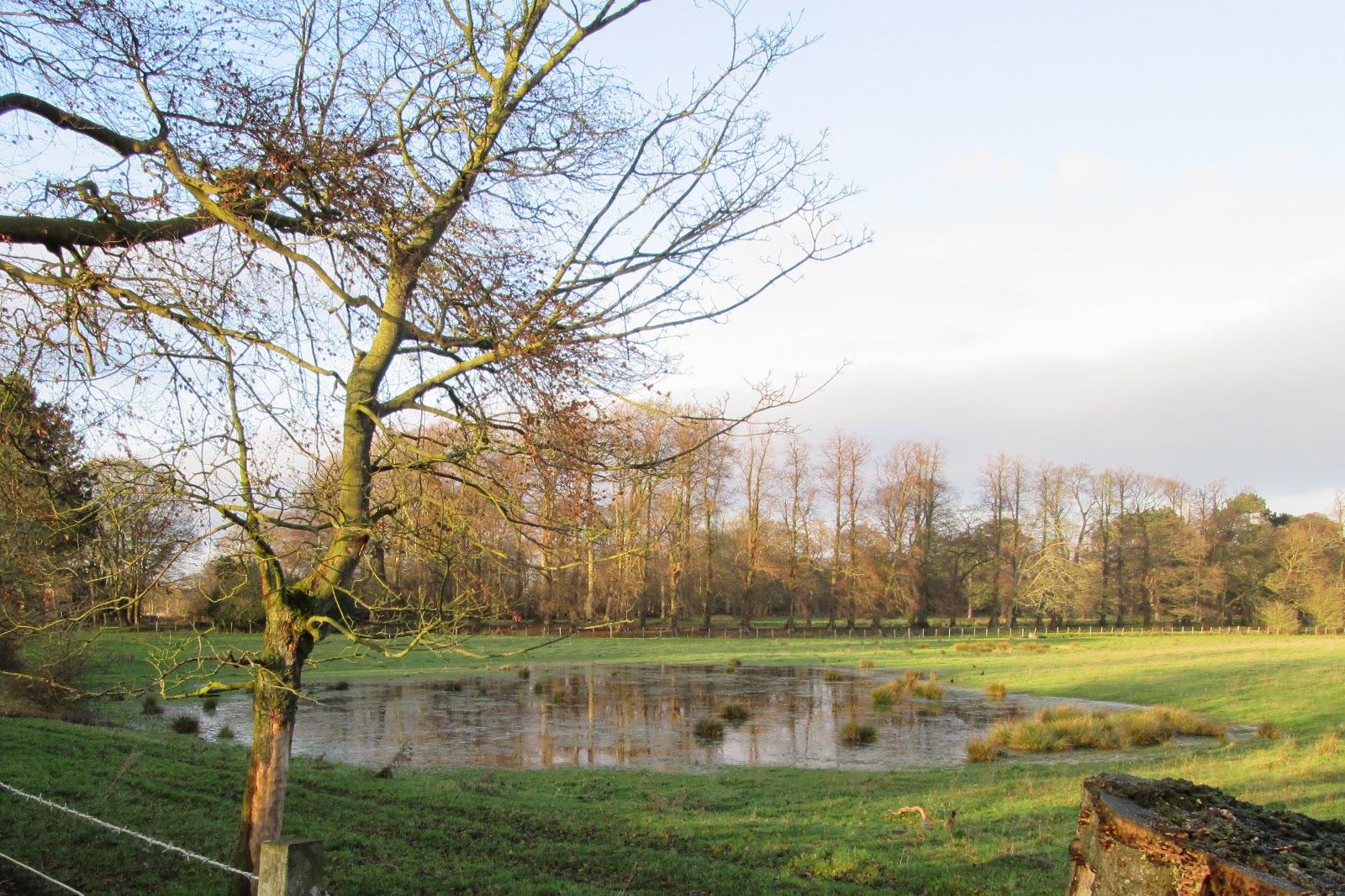
Pond in Field
 Unfortunately it had very little wildlife around it............a couple of Carrion Crows.......which left as soon as I got there. A little further along there was an interesting looking building hiding in the woods next to this field:
Doocot in Woods
It was an octagonal doocot (aka dovecote) built of red brick and I later found out that it was built around 1800 and belonged to the nearby Carron House, which has been a ruined mansion for as long as I can remember. The doocot looked in good condition for its age but had been subject to some obvious vandalism. I guessed it would no longer contain the doves/pigeons which the mansion house bred for pleasure (and food).
Shortly after this point I turned round and headed back towards Grangemouth as I did not think I would find much in the way of wildlife along the short stretch of walkway to Carronshore.
As I approached the outfall from the sewage works I noticed that not only was there still a collection of ducks and gulls, there was also a Heron on the bank beside the outfall:

I'm not sure what the Heron was hoping to catch but I presume it was some small fish which had been attracted to the nutrients from the outfall. I grew up in the Carronshore area and never thought that fish could ever exist in such a polluted river (as it was then); however a huge reduction in amount of heavy industry in the area coupled with major improvements in discharges has I'm sure led to life returning to the lower reaches of the River Carron.
Just downstream of the outfall, where the surplus water from the Forth & Clyde Canal discharges in to the river, I noticed that a group of male Teal where swimming about in a circular motion:

After circling around a bit they started to attack each other, with a bit of 'parallel swimming' thrown in as well. I wondered if this was some sort of breeding display such as male red deer do..............a sort of 'Teal Rut'..........if it was there were no females about to impress.
Normally on the banks of a tidal river (at low tide) you would expect to see some waders but all I saw was one Redshank under the M9 flyover which flew away before I could photograph it. This may have something to do with the very deep and very soft mud that makes up the banks of the River Carron.........as anybody brought up in this area knows, this mud is perilous. To illustrate this I took a photograph of this perfectly serviceable, modern bicycle which has been tossed into the mud only a few feet from the bank side...........and nobody has made any attempt to retrieve it!!!...........as far as we can tell!!
Anybody want a bike?
Well my walk was almost finished and I felt that I had a good day, some wildlife, some antiquities and some curiosities. I was just about to pack my camera and camcorder away when a small flock of birds swooped past and landed in a nearby tree. These were Yellowhammers, one of my favourite birds and surprisingly enough they were happy to sit in this tree and let me film them. Firstly there was a brightly coloured male Yellowhammer:

Unfortunately you could not hear him singing above the noise of the traffic on the M9 motorway.
Then there was the less colourful, but just as beautiful female Yellowhammer:

What a fantastic hour or so I had on this short walk...... and I cannot believe how accommodating the wildlife around this area was...........they just stood there and let me film them.............I definitely must return sometime.

Take Care,

TeddyEdward